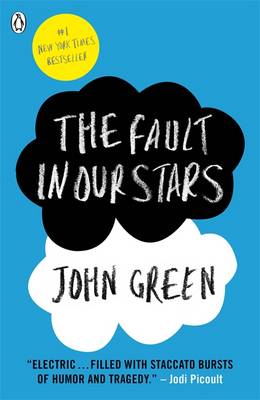
From John Green’s The Fault In Our Stars.
As it is made clearly evident from the opening sentence, this book does waste any time introducing the characters and conflict of the story. Our guide through the story is a teenage girl named Hazel. She is like so many of your (normal) moody and spunky teen girls with one rather large difference… Hazel has terminal cancer that has decided to attack her lungs. Instead of spending her time living in hope of a cure, which she knows would only be false hope, Hazel is living her life waiting to meet her inescapable and looming death. Since she is too sick to go to school (and all her healthy friends have distanced themselves from her), Hazel is often left to read and solemnly await her death; her parents see this as a mental health problem, so they cart Hazel and her little oxygen cart off to a cancer support group for teens. Through a friend at this support group, Hazel meets a boy named Augustus (Gus), a cancer survivor. The two soon find that they share many common interests, and Hazel begrudgingly enters into a dating relationship even though she feels that her impending death will cause more damage than the relationship can handle. All things considered, things go fairly well for Hazel and Gus until he reveals that his cancer has come back again; this forces Hazel to go from being the sick one in the relationship to the girl in the “sick” relationship. Both characters are forced to grow up in the face of terrible happenings and also to choose if they want to grow closer or farther apart through the events of life, no matter the outcome that is waiting somewhere off in the distance. If you’ve watched the movie adaptation, you know that there are more aspects to the story, but I won’t spoil the book for anybody with any more information.
John Green wrote the story loosely based on the life of a real person, so the story comes from a mix of research and fictional creation. It is an incredibly realistic story, both in character development and setting, that attracts readers with an honesty that is printed on every page. This book is filled with sarcasm, blatant honesty, and chances for simple laughter; the characters are raw and real, and the story walks the line between between several genres with ease. John Green does an excellent job of handling very dark and depressing subject matter openly while allowing enough the reader enough of a humorous break to keep from drowning in the heavy material; both aspects of the story are weaved together seamlessly and effectively. Both Hazel and Gus use literature and deep thinking to communicate the complexing emotional mess that are their lives; this helps propel The Fault in Our Stars as one of the most memorable/quotable/thought-provoking books of the modern young adult genre. Green also uses some of these quotes to offer foreshadowing for the observant reader, but the story is not predictable and even events that were hinted to earlier are developed with a twist. The human reaction to disease, especially terminal, is highlighted with each character… we are allowed to watch as each person chooses to ignore the disease, see only the disease, or find the appreciated middle ground. Green uses this book to honor the bravery of battling an illness while also challenging the reader to fight for the good, each and every unfair day.
 First Sentence of a New World
Leave a comment