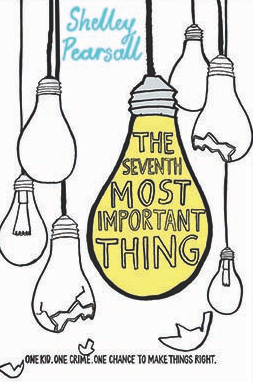
From Shelley Pearsall’s The Seventh Most Important Thing.
In a moment of senseless anger, Arthur threw a brick at the neighborhood Junk Man; Arthur’s actions lead to the man’s broken arm and Arthur being sentenced to complete his probation working for the Junk Man (Mr. Hampton) for four hours every Saturday. On the first day, Mr. Hampton leaves Arthur a list of The Seven Most Important Things (lightbulbs, foil, mirrors, pieces of wood, bottles, coffee cans, and cardboard) and a shopping cart. As Arthur deals with being a junior Junk Man, he struggles with finding the various trash items the list every Saturday, until Arthur sees what Mr. Hampton has been creating in his garage: a giant display of trash-turned-treasure display of Heaven. Slowly, Arthur begins to connect with Mr. Hampton and his mission of completing his artistic masterpiece, but even as probation settles down, Arthur still has to deal with many challenges at home (struggling with the recent death of his father) and school (protecting a nerdy kid named Squeak from bullies). While everyone still expects Arthur to screw up at any minute, Arthur begins to experience The Seven Most Important Things in his day-to-day life that alters the way he views and lives his life.
Pearsall did an amazing job creating a historical fiction novel that easily holds the reader’s attention from the first sentence all the way to the very end. The chapters are short, but packed with details and action; for almost the entire story, it is very difficult to put the book down, because Arthur’s story just flows so well. There are a few minor swear words scattered throughout the book, but overall The Seventh Most Important Thing holds a powerful message for child (and adult) readers about how the choices that we make impact the rest of our life, but don’t have to define us.
 First Sentence of a New World
Leave a comment