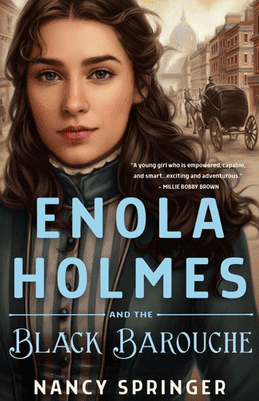
From Nancy Springer’s Enola Holmes and the Black Barouche.
Since reconciling her relationship and desire for independence with her older brothers, Mycroft and Sherlock, young Enola Holmes’ life has been both pleasant and productive. Enola has been able to make decisions for herself while also developing a steady relationship with Sherlock, especially in relation to the siblings’ mystery-solving capabilities. When the distraught Letitia Glover arrives begging for help finding her twin sister, Felicity, Enola and Sherlock are thrown by the information that Flossie was announced dead. However, Letitia insists that she would know if her twin was dead and convinces Enola of the fact with the revelation that Felicity’s husband, the Earl of Dunhench, has a dark past when it comes to the women in his life and the fact that Felicity’s death certificate features the forged signature of John Watson. Sherlock and Enola begin investigating in their unique ways, and Enola reaches out to her old friend, the Marquess of Basilwether, for help in finding clues of noble society and she soon hears mention of a mysterious black barouche connected to Felicity’s disappearance. Deciding that she’ll need to investigate from inside the Earl’s world, Enola creates a disguise and plan that is riskier than anything she’s ever tried before.
The seventh book in Springer’s young detective heroine series is a new addition, but full of the same action as the rest of the books. The mystery is similar in style to Doyle’s Sherlock Holmes stories, but brings a fresh spirit to the gritty world. Some older readers might guess at aspects of the mystery before the reveal, but it is still enjoyable to watch Enola Holmes and the Black Barouche unfold.
 First Sentence of a New World
Leave a comment